
Skip to content
Together, nurturing every child’s potential · Trusted by families across India

When Your Child's Speech Development Is Slow or Hard to Understand

Some children take longer to start talking, and it's natural to wonder about typical infant talking age or whether you should actively encourage speech at home. Others are already talking, but specific sounds are unclear, and people outside the family struggle to understand them.

Both are common concerns around speech development. Mom's Belief addresses both, though the goals look different depending on what your child needs and their current age.

At Mom's Belief, we look closely at infant speech development and newborn speech development in the earliest years. As children grow older, the focus shifts to clarity of specific sounds. Infant language development often overlaps with these early speech milestones, which is why we start by understanding where your child currently stands and build from there.

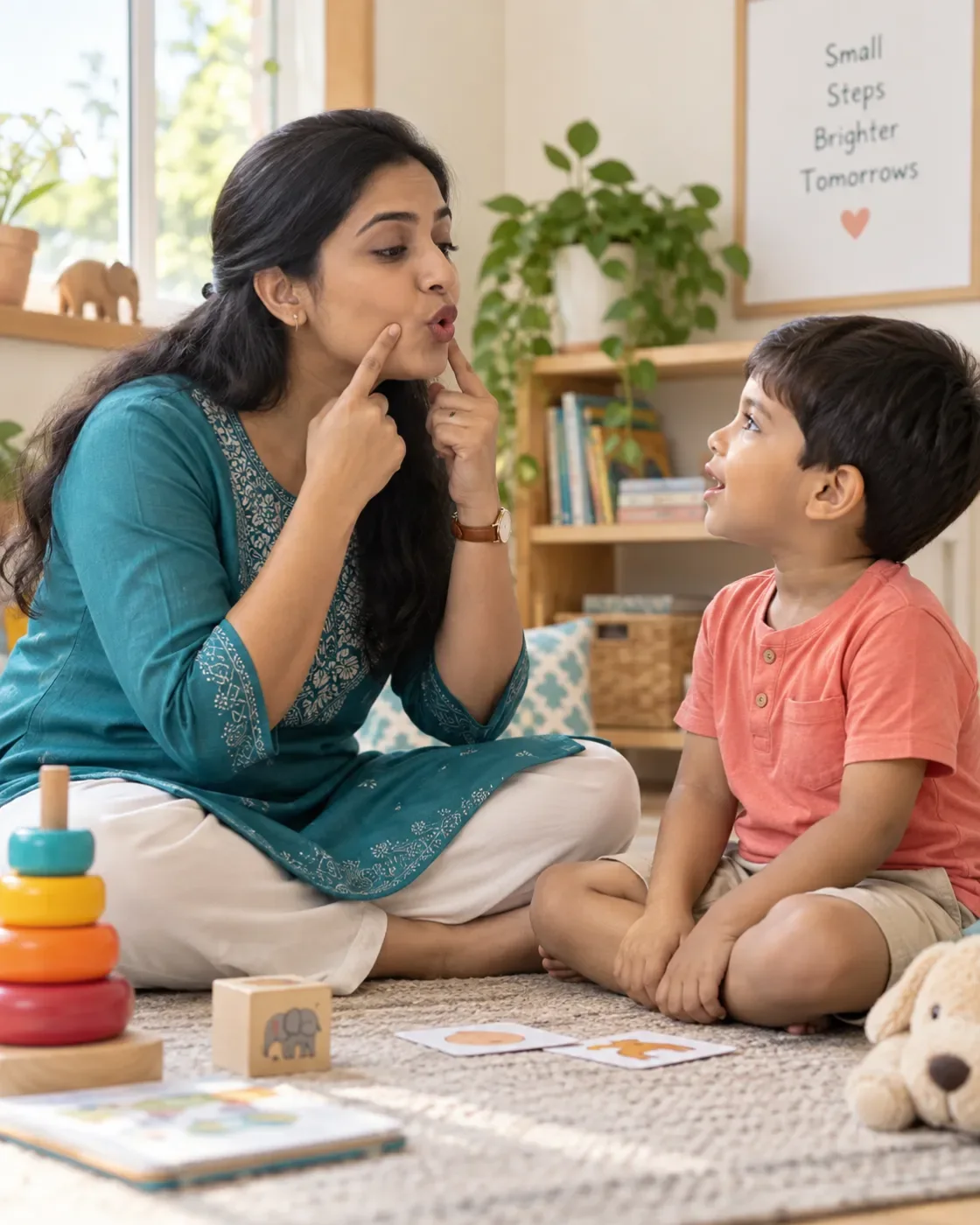
An educator demonstrating a speech sound during a conversation with a child.

What Parents May Notice

You may notice that your child:

  • Isn't using as many words as other children their age

  • Shows a delay in speaking compared to typical milestones

  • Took longer to start babbling or saying first words

  • Leaves out or replaces certain sounds when speaking

  • Is difficult for teachers, relatives or other children to understand

  • Struggles with specific sounds like "s," "r" or "l"

  • Gets frustrated when others don't understand them

  • Speaks less than expected in group or classroom settings

These signs can look different across children. Age plays a large role in what's typical for speech in infants and older children alike. A closer look at your child's speech can help clarify what's going on.

How We Can Help

Speech and Language Therapy

Speech and language therapy at Mom's Belief works to promote speech through sound production, clarity and word use. Therapists set articulation goals for your child's current age and stage, rather than following a fixed program.

Sessions are one-to-one, group or a mix of both. The format depends on what will help your child practise sounds and words in a way that carries into daily life. For a toddler, this might mean activities that encourage speech. For an older child, it might mean refining articulation.

Parent Guidance

After every session, therapists guide parents on what to continue at home and share observations from the session. Families also receive a home intervention plan built around current goals.

The Clinical Manager or Clinical Director arranges separate parent-coaching sessions, and parents can reach out with concerns between sessions.

Progress Looks Different for Every Child

There's no single timeline every child follows for speech development to unfold.

Progress depends on consistency of sessions, how much practice continues at home, how closely the family follows the plan and your child's individual pace. We share observations after every session, along with a formal progress report every three months.

The goal isn't just to complete a therapy activity. It's for your child to be understood, and to communicate comfortably at home, at school and with people outside the family.